What to say
Difficult conversations at work: 18 examples, word for word
Eighteen real moments that go wrong at work, each with the exact words someone says and one line to answer with. Read the moment, then say the line out loud. Each example links to a full page: the follow-up, the one-to-one and what to do if it keeps happening.
These are moments with a boss or a coworker whose behaviour makes work harder: shouting, put-downs, lies, credit taken, constant checking. Most have a practice scene on their page, where you pick an answer and see why it works or backfires.
Try it first: what would you say?
A rumour about a coworker
“Did you hear about Anna? Apparently she messed up the Hartley account and she’s on her way out.”
Eva, your coworker, quietly, at the coffee machine. Anna sits two desks from you. You have heard nothing about it.

With your boss
-
Shouted at in front of the team
Team meeting. Your boss: "Who put these numbers together? This is a mess! Did anyone even check them?" The numbers are yours.
"They're mine. I'll check them today and send a fixed version by 2. Can we go through it after the meeting?"
-
A dig in front of the client
Client call. Your boss, smiling: "Well, I suppose that's one way to build a slide. Don't worry, we'll get you there eventually."
"I put the cost first because that was the client's first question. Happy to reorder it if that works better."
-
Your idea, presented to your boss's boss
Leadership review. Your manager, to her director: "I've been looking at why renewals dropped, and I think I've found the fix." The idea and the numbers were in your email to her last Friday.
"Yes, and I can add the numbers behind it. When I ran the renewal data last week, week two came out clearly ahead. Happy to share the sheet."
-
"I never said Friday"
One-to-one. Your manager: "Why isn't the report done? I never said you could push it to Friday. We agreed Wednesday." On Monday he wrote in the team chat: "Friday is fine."
"I may have misread it. I have your message from Monday saying Friday works, I'll forward it now. If you need it Wednesday, what should move?"
Practise this scene: when your boss denies what was agreed →
-
"Did you even read the brief?"
Email, team on copy. Your manager, replying to all: "Did you even read the brief? This is not what I asked for. I need it fixed today."
To your manager only: "Thanks, I'll fix it today. So I get it right: is it the structure or the numbers? I can come by at 2 to go through it."
-
The third "any update?" since lunch
Team chat. Your manager: "Any update on the deck?" The deck is due Thursday and it is on track.
"Quick status: the draft is done, the numbers are on track for Thursday, nothing is blocked. Would a quick sync at 11 every day work?"
-
Your boss heard a lie about you
Your manager's office. "Tom tells me the client report went out late on Friday, and they weren't happy. What happened?" You sent it on Thursday at 4.
"That's not right. I sent it on Thursday at 4. I'll forward you the email now."
With a coworker
-
Your work, in someone else's mouth
Team meeting. A coworker presents: "When I dug into the churn numbers, I found the drop comes from the second onboarding email." It was your analysis.
"Thanks for raising that. When I put the analysis together, the key thing I found was the timing of that email. Happy to go through the details."
-
A deadline from someone who isn't your boss
Team chat. "Mark wants the risk slides by Thursday, so can you get them to me first?" She isn't your manager, and you never heard Mark say it.
"Good to know. I'll confirm the details with Mark, so I get it right."
-
Your own model, explained to you
Client meeting. A coworker, slowly: "So the forecast basically works like this…" You built that model.
"Thanks, I'm across the model. The part I'd like your view on is the supplier risk."
-
The figures that never arrive
Stand-up. You ask about figures promised for Monday. It's Wednesday. "Oh, I didn't realise it was urgent. No worries, I'll just drop everything for you."
"Thanks. Thursday noon works, so I can send it on Friday. Can you do that?"
-
You find out they reported you to the boss
After the stand-up. Tom, on the way out: "Just so you know, I told Mark your report was late. I thought he should know." He never mentioned it to you.
"Fair enough. Next time, tell me first. I can usually fix it the same day."
Practise this scene: a coworker who tells the boss everything →
-
Your idea, shot down before you finish
The project meeting. Tom, halfway through your proposal, in front of Maria and the team: "Sorry, but this won't work. We tried something like it last year." It is the third time this month.
"Let me finish the point, then I'd really like to hear the risk you see."
-
Your words come back twisted
The team meeting. Tom, to Maria, in front of the team: "Like you said yesterday, we'll have it all by Friday." Yesterday you said the date depends on the data.
"That's not quite what I said. What I said was that the date depends on the data. Happy to put it in writing."
In meetings and at your desk
-
Cut off mid-sentence, again
Team meeting. "Sorry, just to jump in here, I think the real issue is the budget." The third time this meeting.
"One second, let me finish. Then I'd like to hear your view on the budget."
-
The story that won't end
Your desk. A coworker, ten minutes into a story. It's 2:20, and your report is due at 3.
"I want to hear the rest, but I'm on a deadline until 3. Tell me at coffee?"
With someone you manage
-
Feedback, and then tears
One-to-one. "I worked all weekend on this. I guess nothing I do is good enough." The client needs the report on Friday.
"I get that it's hard. We still need it by Friday."
How to role-play these at work, in ten minutes
You need one other person and this page. No script, no props.
- Pick one example. One person reads the other side's words exactly as written, in the tone they'd really have.
- Answer out loud. Say the line, not a summary of it. Then try the version that usually backfires, on purpose, and notice what it does to the room.
- Swap roles. Hearing the line from the other side shows you why it works.
- Write your own. One moment from your own week: where it was, the exact words said, and the line you wish you'd had. Play that one last.
Alone? Say the line out loud three times before the meeting where you expect to need it. Reading it is not the same as having said it.
Write your own example
The examples that help most are the ones you write about your own work. Use this shape:
"When [who] says '[their exact words]' in [where], I'll say: '[one sentence: the fact, then what happens next]'."
Keep your line to one or two sentences. If it needs three, it is a speech, and you won't say it under pressure.
Free to print: the phrase sheet
Want the lines on paper? The free phrase sheet has 15 lines for the hard moments on one page, as a PDF. No sign-up. For the blunt thing you want to say, try Say it calmly.
When it is a pattern, not one conversation
One line handles one moment. If the same behaviour comes back every week, the line is not the fix. Keep short dated notes of what was said and who was there, raise it one to one with one example and one request, and then take it to your manager or HR. Not sure if it's your boss or you? Take the 2-minute boss check. This page is not legal advice.
Published
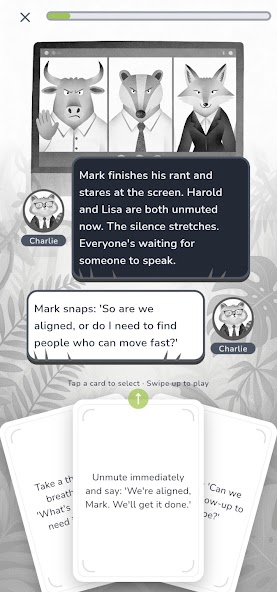
Practise it in SNAXE
Reading the words is easy. Saying them in the moment is harder.
SNAXE puts you in short workplace scenes. You pick what to say, then see what works. Five minutes a day.