
What to say
How to deal with a snake coworker: what to say
The short answer: don't hiss back. Put what you agree in writing, ask calmly when your words come back twisted, and let people see your work for themselves. "That's not what I said. Here's the note from Tuesday." Over time, the facts carry more weight than the whispers.
First, a quick check: a snake, or a misread?
Calling someone a snake is a big step. Before you treat a coworker as one, ask yourself three questions.
- Did you hear it from them, or about them? Stories change as they pass from person to person. What reached you may not be what they said.
- Is it a pattern? One odd comment is a bad day. The same twist, three times, in front of the people who matter, is a pattern.
- Who gains? If their version always makes them look better and you look worse, it is less likely to be an accident.
If it is a pattern, use the lines below. They share one move: you stay calm, and you make the facts easy to see. You don't need to win an argument about who they are.
Try it first: what would you say?
Your words came back twisted
“Like you said yesterday, we'll have it all by Friday.”
Tom, to Maria, in front of the team. Yesterday you said the date depends on the data.

Say this, in the moment
-
When your words come back twisted
"That's not quite what I said. What I said was that the date depends on the data. Happy to put it in writing."
Correct the record, not the person. Offering to write it down shows you have nothing to hide.
-
When they smile and agree, then do something else
"Just to recap what we agreed: you send the figures by Thursday, I draft the slides Friday. Shout if I've got that wrong."
Send it right after the meeting. A friendly recap is hard to argue with later.
-
When they take a dig at you in a meeting
"I see it differently. Can we look at the numbers together after this?"
One calm sentence, then move on. A public fight is the story they want to tell.
-
When someone tells you what they said about you
"Thanks for telling me. I'll talk to them directly."
Don't add your own version to the chain. Go to the source.
-
If they deny it: "I never said that"
"Okay, then let's make sure we're on the same page now. I'll send a short note after this."
You don't need them to admit anything. You need the next version on paper.
Afterwards, one to one
If it keeps happening, ask for a quiet word. Lead with what you saw, not with what they are.
"I've heard that I said the project would slip. I didn't say that. I'd rather sort it out with you directly. Did I give you that impression?"
If they explain a real misunderstanding:
"Thanks, that helps. Let's agree that if something I say sounds off, you check with me first. I'll do the same."
If they brush it off:
"Fine. From now on I'll send a quick note after we agree something, so we both have the same version."
That last line isn't a threat. It's a habit, and it quietly takes away their raw material.
Depending on who it is
-
A peer at your level
"If something I do bothers you, tell me. I'd rather hear it from you than from someone else."
-
Someone senior, or close to the boss
"I want to make sure we're aligned. Can I send you a short summary after each of our check-ins?"
You can't out-talk someone the boss trusts. You can leave a written record nobody can twist.
-
In chat
"Adding the team so everyone has the same version: we agreed Friday for the draft, and the figures come from Anna."
Move the key agreements out of private messages and into the shared channel.
The line people usually say, and a better one
- "You're such a snake." Whatever they did, the label becomes the story, and you look like the aggressor. Try: "That's not what I said. Here's what I said."
- Spreading your own version behind their back. Now there are two snakes. Try: talk to them, or put it in writing.
- Avoiding them completely. It leaves the room to them. Try: stay polite, stay present, and keep your notes.
- Venting to the team. It travels, and it travels twisted.
If it keeps happening: telling your manager
Your best protection is that your manager sees your work first-hand. A short weekly update does most of that work.
"Quick weekly update: the report is on track for Friday. One risk: the client data is late. I'll flag it if it moves."
If the stories start to shape how your manager sees you, raise it as a question about facts, not a complaint about a person.
"Can I check something? I've heard I said the project would slip. I didn't. If you ever hear something about my work, I'd like the chance to show you the notes."
Keep a short record of each time it happens: the date, what was said, who told you, and what you had in writing. For example:
"12 Nov. Told by Tom that I'd blamed the client team for the delay. My email of 10 Nov says the data arrived late, and names no one."
A record like this shows a pattern without you calling anyone a snake. If the stories turn into false claims about you, or start to affect your review, HR is the next step. Your notes go with you.
Published
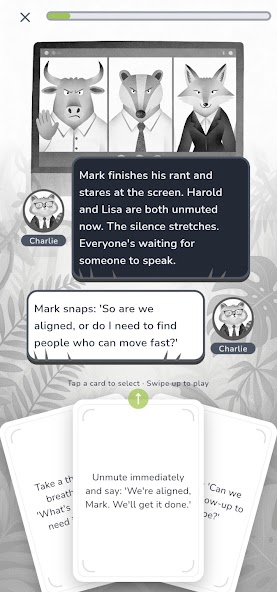
Practise it in SNAXE
Reading the words is easy. Saying them in the moment is harder.
SNAXE puts you in short workplace scenes. You pick what to say, then see what works. Five minutes a day.