
What to say
When your manager takes credit for your work: what to say
The short answer: don't call it out in front of their boss. Add your part out loud, calmly, so the room hears that you know the detail. Then, one to one, ask for one thing: your name on it, or a slot to present it, next time. Your boss writes your review, so aim for visibility, not an admission.
First, a quick check: normal manager credit, or taking yours?
Presenting the team's work upwards is part of a manager's job. Your boss saying "we found" in a leadership meeting is not theft. Ask yourself four questions.
- "We" or "I"? "The team found" shares it. "When I dug into it, I found" claims a piece of work they didn't do.
- What happens when someone asks a detail? A manager who shares credit says "Jana ran that, she can tell you". One who takes it answers alone, or promises to "get back to you".
- Does your name reach the people who decide your pay and promotion? If your boss's manager has never heard of your work, the credit isn't reaching you, whatever the intent.
- Once, or every time? Only you, or the whole team? One rushed summary needs one conversation. A habit needs a paper trail.
Not sure what you're dealing with? Take the 2-minute boss check. If it's a coworker taking credit, not your boss, see what to say when a coworker takes credit. The words differ because the power differs: a coworker can be corrected as an equal, but your boss decides your review, so every line here protects the relationship while it puts your name back on the work.
Try it first: what would you say?
Your idea, presented to your boss's boss
“I’ve been looking at why renewals dropped, and I think I’ve found the fix: we move the price reminder to week two.”
Priya, your manager, to her director. The idea and the numbers were in your email to her last Friday.

Say this, in the moment
-
When they present your work to their own boss
"Yes, and I can add the numbers behind it. When I ran the data last week, week two came out clearly ahead."
"Yes, and" backs your boss; "when I ran" puts your name on the work. You add detail only the person who did it would know.
-
When they repeat your idea as theirs, minutes after you said it
"Glad that's landing. When I raised it earlier, I was thinking we start with the March customers. Shall I draft the plan?"
You link it to what you said and take the next step. Whoever writes the plan is the person the room remembers.
-
When someone senior asks a question about your part
"I can take that one, I built the model. The short answer is..."
Questions are your opening. Answer short and well. Don't wait for your boss to hand it to you.
-
When they ask you to send your work so they can present it
"Happy to. Could I join for the analysis part, in case there are questions? It would help me learn how leadership thinks about it."
Ask before, not after. A request framed as learning is easy to say yes to, and hard to refuse without saying why.
-
When your name is missing from the report or email
"I saw the summary went out to Sam's team. Could you add me as the contact for the analysis, so questions come straight to me?"
Say it to your boss, not as a reply-all. You ask for a practical fix, not an apology, and the fix puts your name in front of the right people.
-
When their boss praises them for your work, in front of you
"Thanks, it was a good one to work on. I'm happy to walk anyone through the data."
You accept the praise for the team and quietly make yourself the expert. Correcting the record in that moment helps nobody.
Afterwards, one to one
Within a day or two, ask for ten minutes. Make it about your growth, not their behaviour. Name one example and one request.
"Can I have ten minutes about visibility? I want to grow here, and part of that is the people above you knowing what I can do. The renewals fix was my analysis. Next time, could I present my part, or could you mention me by name?"
If they say it's a team effort:
"It is, and I'm glad to be on the team. I'm only asking that my part carries my name, so I can be asked about it."
If they say they are accountable for everything the team does:
"I understand you carry the result. I'm not asking for less of that. I'm asking to be in the room for my part."
If they say it will show in your review:
"Thanks. Then could we write down now what goes in it, so we both remember it the same way?"
Don't argue about whether they took it. You need their yes to the next time, not an admission about the last one.
Then, a short note in writing
Send it the same day. It confirms the agreement, in neutral words, with a date on it.
"Thanks for the chat today. To confirm: I'll present the renewal analysis at the review on the 12th, and I'll be the contact for questions on it. Let me know if I've missed anything."
No feelings, no "as discussed". It reminds you both of the agreement, and it is a dated record that you asked.
Next time, before anyone presents it
-
A short weekly update to your boss
"This week: finished the renewal analysis (attached), started the pricing test, nothing blocked."
Three lines, every Friday. Your boss has something to forward, and you have a dated trail of what you did.
-
Your name on the work itself
"Renewal analysis, March. Prepared by Jana Novak."
A name on the first page or in the file name travels when the file is forwarded. It isn't vanity; it is how people know whom to ask.
-
Agree who presents, at the start
"For the review: should I present the data part, or would you like to? Either works, I'd just like to know."
Asked early, it is planning. Asked after the meeting, it sounds like a complaint.
-
A file of your wins
One line per result: the date, what you did, the outcome, who saw it. Before your review, it turns "I did a lot this year" into a list nobody can forget.
The line people usually say, and a better one
- "That was my idea" in front of their boss. True, maybe, and your boss now has to defend themselves in public. Add your detail instead: "When I ran the numbers..."
- Going to their boss behind their back, first. It turns a fixable habit into a loyalty question. Ask your boss first; go higher only if asking doesn't work.
- Holding back your best ideas. It protects the idea and hides you. Share it in writing, with your name and a date, instead.
- Complaining to coworkers. It travels, usually to your boss, and usually in a worse version.
- Saying nothing, every time. Your boss may not even know it bothers you. One calm request often fixes it.
If it keeps happening: your record, a career conversation, and HR
If you've asked and nothing changes, keep the weekly updates and the wins file going. They are your record. Then talk to your boss's manager, framed as your development, not their faults.
"I'd value your view on my development. Here are the three pieces of work I led this year, with dates. I'd like to know how I can take on more of this."
Lead with your work, not their behaviour. If your boss's manager asks why you came to them, say plainly that your work hasn't been visible above your boss, and that you raised it with your boss on the 12th. If credit is affecting your pay, your rating or a promotion, take your record to HR in writing. Some fields have formal rules on authorship or inventions; check your employer's policy. This page is not legal advice.
Published
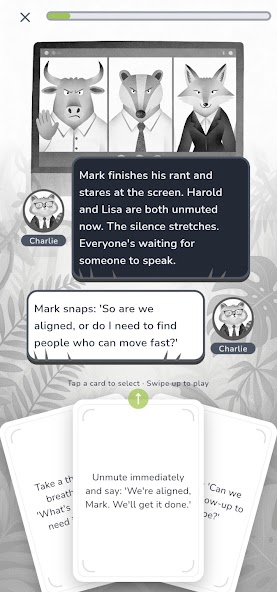
Practise it in SNAXE
Reading the words is easy. Saying them in the moment is harder.
SNAXE puts you in short workplace scenes. You pick what to say, then see what works. Five minutes a day.