
What to say
When your boss denies what was said or agreed: what to say
The short answer: don't argue about whose memory is right. Say calmly what you have in writing, or what you understood, and agree now what happens next. Then send a two-line note the same day. Every agreement that matters goes into writing, so nobody's memory has to carry it.
First, a quick check: a memory slip, or a pattern?
Everyone forgets things, bosses included. A busy manager who mixes up two conversations is not rewriting history. Ask yourself five questions.
- Once, or again and again? One mix-up needs one correction. The same denial every few weeks needs a record.
- Which way does it fall? Honest mistakes go both ways. If the changed version always clears your boss and puts the fault on you, that is worth noticing.
- What happens when you show the message? "Oh, right, my mistake" is a slip. "That's not what I meant", "you're overthinking it" or a new version each time is something else.
- Is it about the facts, or about you? "I said Wednesday" is a fact you can check. "You always get this wrong" or "you're too sensitive" moves the talk from the facts to you.
- Only you, or others too? If teammates hear the same denials, you are not imagining it, and you are not the only one who needs a record.
People often search for "boss gaslighting me" when this happens. You don't need to decide what your boss intends, or name it. You need a record that doesn't depend on anyone's memory. Not sure what you're dealing with? Take the 2-minute boss check. If it's a coworker telling your boss something false about you, see what to say when a coworker lies about you. If it's digs and put-downs, see what to say when your boss belittles you.
Try it first: what would you say?
"I never said Friday"
“Why isn’t the report done? I never said you could push it to Friday. We agreed Wednesday.”
Mark, your manager. On Monday he wrote in the team chat: “Friday is fine.”

Say this, in the moment
-
When they say they never agreed to it
"I may have misread it. I have your message from Monday saying Friday works, I'll forward it now. If you need it Wednesday, what should move?"
"I may have misread it" lets your boss off the hook. The message settles the facts. The question moves you both to what happens next.
-
When they say they never told you to do it
"I did it the way I understood it from Thursday's call: the short version, client numbers first. If you'd like it another way, tell me now and I'll change it."
You say what you understood, with the date and the detail. You don't call anyone a liar, and you offer the fix.
-
When there is nothing in writing
"We may remember it differently. Let's agree it now: the report on Wednesday, the pricing part left out. I'll send a quick note so we both have it."
Without a record, nobody can win the argument about the past. So skip it, agree the future and write that down.
-
When they deny it in front of the team
"I may have misunderstood. I'll check my notes and send a summary after the meeting, so we're all working from the same version."
Don't fight it out in public. The summary goes to everyone who was there, and it becomes the version everyone has.
-
When they say you're remembering it wrong, or overthinking it
"Maybe. That's why I'd like to write these down, so neither of us has to rely on memory."
You agree with the part that could be true and keep the request. It is hard to object to a note that protects you both.
-
When the target changes after you hit it
"Last week the priority was the client numbers, and they're done. If the priority is now the forecast, I'll switch. Can we put the new one in writing?"
You name both versions, with no blame, and ask for the new one in writing. Changing priorities is a boss's right; changing the past isn't.
Afterwards, one to one
If it has happened more than once, ask for ten minutes. Make it about how you work together, not about their memory. Bring one example and one request.
"Can I have ten minutes about how we agree things? Twice this month we've remembered a deadline differently, and it cost us both time. From now on, could I send a short note after we agree something, and you tell me if I've got it wrong?"
If they say "I never said that" again:
"I understand that's how you remember it. That's exactly why I'd like to write these down from now on."
If they ask why you are writing everything down:
"It helps me not drop things. And if I've got something wrong, you can correct it the same day, not a week later."
If they say you're being too sensitive:
"Maybe. I'm not asking about feelings, only about dates. A two-line note fixes that for both of us."
Don't ask them to admit they changed their story. You need their yes to the note, not a confession about the last time.
Then, the note: confirm every agreement in writing
Send it the same day, by email or in the chat you normally use. Two or three lines. Neutral words. A date on it.
"Thanks for the chat today. To confirm: the report is due Wednesday the 12th, without the pricing section, and I'll send a draft on Monday. Let me know if I've got anything wrong."
"Let me know if I've got anything wrong" matters. It gives your boss a fair chance to correct it, and if they don't, the note stands. No feelings, no "as you said last time".
Keep your own record
-
Decisions go into email or chat, not only into talk
"Quick check before I start: you'd like the short version, client numbers first, by Wednesday. Right?"
One line before you begin a task. It costs ten seconds and saves the argument a week later.
-
A note on the day, for the things you can't email
The date, what was said or agreed, who was there. Facts only, in your own words, written the same day. Notes made at the time are far more use than memories rebuilt weeks later.
-
Keep copies that are yours
Save the messages that matter somewhere you control and are allowed to use, such as a work notebook. Follow your employer's rules on company data.
-
A summary after meetings
"Summary from today: we agreed A, B and C. Mark owns B, I own C, due Friday. Shout if I've missed anything."
Sent to everyone who was there. Whoever writes the summary writes the version people remember.
The line people usually say, and a better one
- "You're lying," or any label for your boss. It turns a date into a verdict on your boss's character, and the talk is now about the label. Point to the record instead: "I have your message from Monday."
- "You did say that!" Two memories against each other. Nobody wins, and you look like you're fighting. Say what you understood, then agree what happens next.
- Apologising for something you didn't do. It ends the moment and makes their version the official one. "I understood it differently" is honest and still calm.
- Recording your boss in secret. In many places and workplaces it is against the rules, and it can cost you more than it proves. A same-day note is legal everywhere and almost as strong.
- Doubting yourself in silence. If you are second-guessing your own memory, look at the note you wrote at the time. That is what it is for.
If it keeps happening: your record, someone with more power, and HR
If you've asked for notes and the denials go on, keep the notes going. They are your record: dates, the words, the message that shows what was agreed. Then talk to your boss's manager, or to HR, and lead with the record, not with labels.
"I'd like some help with how agreements work in my team. Three times since September a deadline or an instruction I had in writing was later denied. Here are the dates and the messages. Can we find 30 minutes?"
Dates and messages are easy to check, and they keep the talk on the facts. If the denials are about pay, hours, safety or a formal warning, put your concern to HR in writing. This page is not legal advice; your local employment rules decide what applies. And if constant doubt about your own memory is wearing you down, talk to someone you trust, or to a doctor. Many employers also offer a free, confidential support line.
Published
Practise it in SNAXE
Reading the words is easy. Saying them in the moment is harder.
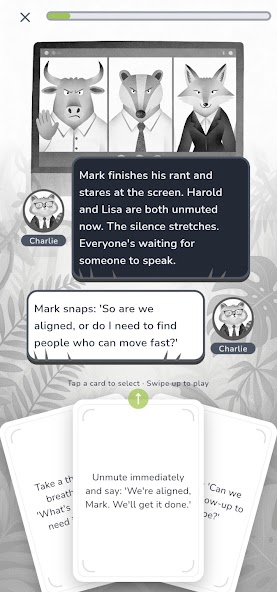
SNAXE puts you in short workplace scenes. You pick what to say, then see what works. Five minutes a day.