
What to say
How to reply to a rude email at work: what to write, word for word
The short answer: wait before you reply, answer the work and leave the tone alone. Keep it to three or four lines: thank them, give the fact or the next step, and ask one question if you need it. If the problem is the tone itself, don't answer it in writing. Walk over, or call.
First, a quick check: reply in writing, or walk over?
Email strips out the voice. A message written in a rush can read as rude when it was only short. And a sharp reply reads sharper than you meant. So decide first where the answer belongs.
- Reply in writing when there is a fact to correct, a date or a task to confirm, or a record you'll want later. Writing is also right when the sender is remote and a call would feel bigger than the email.
- Walk over or call when the tone is the real problem, it's the second or third email like this, the thread is getting longer with every reply, or you are still angry. Talk fixes in two minutes what five emails make worse.
- Read it once more, as if it were written in a hurry. "Fix this today" from someone with twelve meetings may be pressure, not contempt. If it still reads as rude the second time, it probably is.
- Check who is on copy. Your boss, the team or a client on the thread changes who you reply to. It never changes the tone you reply in.
Rude, condescending and passive-aggressive emails need slightly different replies, so the replies below are grouped by who sent it and what it does. For one or two lines in the moment, see a passive-aggressive coworker or a condescending coworker. For a calm way to say a single blunt line, try Say it calmly. Not sure if it's one bad email or a pattern from your boss? Take the 2-minute boss check.
Try it first: what would you say?
"Did you even read the brief?"
“Did you even read the brief? This is not what I asked for. I need it fixed today.”
Petra, your manager, replying to all. The whole team is on copy.

Reply with this: whole emails, by who sent it
Copy the shape, change the details. Each one is short on purpose: the shorter and calmer your reply, the more their tone stands out, not yours.
-
A rude email from your boss
"Hi Petra,
Thanks, I'll fix it today. So I get it right: is it the structure or the numbers that's off? I can come by at 2 to go through it, or send you a revised version by 4.
Thanks, Jana"You accept the work point, ask the one question that makes the fix right, and offer a time. No apology for the tone, no defence of yourself. If the criticism was wrong, say so in person, not in the thread.
-
Your boss criticises you with the team on copy
To the team: "Thanks, I'm on it. Updated version by 4 today."
To your boss only: "Hi Petra, I'd like to get this right. Could we take five minutes at 2? I want to check what was missing from the brief."The team gets one neutral line, so the thread ends. Everything else goes to your boss alone. Then raise the copy list in person: "Next time, could you send me the feedback first? I'll fix it faster."
-
A coworker complains about you and copies your boss
"Hi Tom,
Thanks for flagging it. The figures were late because the supplier file came in on Tuesday, not Monday. They're in the shared folder now. Next time, ping me directly and I'll sort it the same day.
Jana"Leave your boss on copy, since they saw the complaint and should see the answer. Give the facts once, without blame, and ask for a direct message next time. Don't add more people, and don't take anyone off.
-
A condescending email: "as I already explained"
"Hi Tom,
Thanks for the detail. I've added the Q3 figures to the forecast; the new version is attached. One question so I don't guess: should travel sit under the team budget or the project?
Jana"Answer the content and skip the dig. Asking a real question shows you're not rattled, and it is hard to talk down to. More on the person behind it: how to deal with a condescending coworker.
-
A passive-aggressive email: "per my last email", "just a gentle reminder"
"Hi Tom,
Thanks for following up. The contract went to legal on Monday. I've chased them today and will forward it the moment it's back, by Thursday at the latest.
Jana"Two lines, a time, and nothing about the tone. If something did slip, own it in four words: "Sorry, that slipped. Sending now." More on the pattern behind it: how to deal with a passive-aggressive coworker.
-
A rude email from a client
"Hi Mr Novak,
Thank you for telling me. I understand the delay has caused you a problem. Here is where it stands: the order left our warehouse today and will reach you on Thursday. I'll confirm when it's delivered. If it would help, I'm happy to call you this afternoon.
Kind regards, Jana"Acknowledge the problem, not the insult. Give the facts and the next step, and offer a call. If the client crosses a line (threats, slurs, personal insults), stop replying and pass it to your manager.
-
When the rude email is right about the mistake
"Hi Petra,
You're right, the totals were wrong. I've fixed them and checked the rest of the sheet. The corrected version is attached. I've added a second check before I send figures from now on.
Jana"Own the mistake, show the fix, and say what changes. That ends it faster than any defence. You can still raise the tone later, in person, once the work is settled.
Before you press send
-
Wait
Write the reply you want to send, then don't send it. Come back after a coffee, or the next morning if nothing is urgent. The reply you send after waiting is almost always shorter.
-
Delete the first paragraph
The first paragraph of an angry reply is usually the defence: what you did, why it wasn't your fault. Cut it, and see if the email still works. It usually does.
-
Read it as if your boss's boss will see it
Emails get forwarded. If you'd be fine with anyone reading your reply, send it.
-
Check the copy line, and the reply-all
Reply to the people who need the answer. Adding your own manager to "defend" you turns a bad email into a dispute.
When you walk over instead: what to say in person
If it's the tone, or it keeps happening, talk. Keep it about the emails, not about their character. One example, one request.
"Have you got two minutes about this morning's email? It read as quite sharp, and I wasn't sure if something was wrong. If there's a problem with my work, I'd rather hear it straight from you."
If they say "it was just an email" or "you're reading too much into it":
"Maybe, email loses the tone. That's why I came over. Is there anything about the report you'd like done differently?"
If it's your boss and it keeps happening:
"Can I ask one thing about feedback? When it comes by email with the team copied, it's hard to fix quickly. Could you send it to me first, or tell me in person? I'll turn it round faster."
Don't ask them to admit the email was rude. You want the next one to be different, not an apology for the last one.
The line people usually write, and a better one
- "Per my last email" back at them. It answers a dig with a dig, and it reads worse from you if they are senior. Paste the key line again instead: "The date is in my note from Tuesday: Friday the 14th."
- Five paragraphs of defence. The longer it is, the more it looks like guilt. Facts in one or two sentences, then the next step.
- Sarcasm, or "I'm sorry you feel that way". It reads colder in writing than you mean it to. Plain words, plain facts.
- Forwarding it to friends at work to vent. Forwarded emails travel. Talk to someone outside work, or keep it in your own notes.
- Taking your boss off copy, or adding a new one. Both turn the reply into a move in a fight. Keep the same people, and say the rest in person.
- A label for the sender. "That was unprofessional" moves the talk to their character. Describe what happened: "The email went to the whole team before I'd seen the feedback."
If it keeps happening: save the emails, then someone with more power
One rude email is a bad day. Rude emails every week are a pattern. Save them somewhere you're allowed to keep them, and add a short note with the date and what happened next. Then talk to your boss's manager, or to HR, and lead with the emails, not with labels.
"I'd like some advice about emails from my manager. Since October, feedback on my work has come four times by email to the whole team, before I'd seen it. Here are the emails. Can we find 30 minutes?"
Emails are their own record: dated, word for word, hard to dispute. If they include threats, insults about who you are, or anything about pay, hours or a formal warning, put your concern to HR in writing. This page is not legal advice; your local employment rules decide what applies. If it's your boss and it's more than emails, see what to say when your boss belittles you.
Published
Practise it in SNAXE
Reading the words is easy. Saying them in the moment is harder.
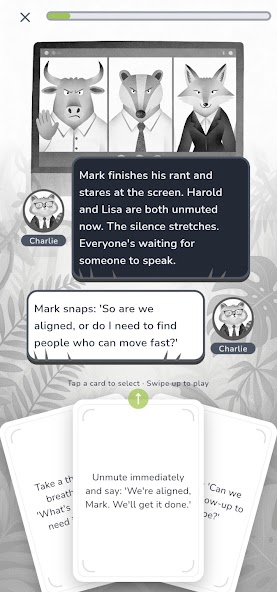
SNAXE puts you in short workplace scenes. You pick what to say, then see what works. Five minutes a day.