
What to say
When your boss belittles you in front of others: what to say
The short answer: don't laugh along, and don't trade jabs back. Answer the work point in one calm line, as if the put-down wasn't there. "Fair question. Here's why I did it that way." Then raise the put-downs themselves, one to one, with one example and one request.
First, a quick check: tough feedback, or a put-down?
A boss is allowed to tell you your work isn't good enough. A put-down is different: it aims at you, not at the work. Ask yourself four questions.
- Is there something specific to fix? "The figures in section two are wrong" is feedback. "Did you even try?" is not, even if the figures are wrong.
- Is it about the work, or about you? Comments on your intelligence, your age, your accent or "people like you" go past criticism.
- Did it need an audience? Feedback that could have waited for a one-to-one, said in front of the team, is doing a second job.
- Is it once, or every week? Everyone, or mostly you? One sharp comment on a bad day needs one conversation. A weekly habit aimed at you needs notes.
Not sure? Take the 2-minute boss check. If your boss raises their voice, see what to say when your boss yells at you; this page is for put-downs said at a normal volume: sarcasm, digs, dismissive comments and criticism in front of others.
Try it first: what would you say?
A dig in front of the client
“Well, I suppose that’s one way to build a slide. Don’t worry, we’ll get you there eventually.”
Marc, your boss, smiling, on a call with the client. He says it in a normal voice. The slide is yours.

Say this, in the moment
-
When they make a sarcastic joke at your expense
"Here's why I did it that way: the client asked for cost first. Happy to change it."
Answer the question inside the joke, not the joke. No laugh, no sigh. A dig that gets a calm reason instead of a reaction has nowhere to go.
-
When they wave away your idea in a meeting
"Before we move on, can I take one minute on why I suggested it? Then it's your call."
You ask for one minute, not a debate, and you hand the decision back. If they still say no, you've been heard, and the room saw you ask calmly.
-
When they criticise you in front of the team
"Understood. I'd like to get it right. Can we go through the details after this?"
Take the point, not the stage. Moving the detail to a one-to-one is not hiding; it is where the fix can actually happen.
-
When it's about your ability, not the work
"Tell me what you'd want to see, and I'll get it there."
"Even an intern could do this" has no fix in it. Your line asks for the fix. It makes them say something specific, or say nothing.
-
When they talk down to you or explain it slowly
"I've got that part. The bit I'd like your view on is the timeline."
Say it evenly and steer to the real question. You don't need to prove you understood; you show it by asking the next thing.
-
When they correct you in front of a client
"Good catch. I'll send the updated figure today."
In front of a client, protect the work and the team, not your pride. If the correction was wrong, fix it with your boss afterwards, in private.
Afterwards, one to one
Within a day or two, ask for ten minutes. Start with the work, then name one example and one request. One example is enough; a list sounds like a case file.
"Can I have ten minutes about Tuesday's call? I want your feedback, and I want to use it. When the slide comment was made in front of the client, it was hard to hear what you actually wanted changed. Could you give me that kind of feedback one to one?"
If they say it was just a joke:
"I get that it was meant lightly. In front of a client, it landed differently. I'm only asking for one to one next time."
If they say you're too sensitive:
"Maybe. I'm not asking you to soften the feedback. I'm asking where you give it."
If they say they're just being direct:
"Direct works for me. Tell me exactly what's wrong and I'll fix it. That's easier one to one."
Don't argue about whether it was a put-down. You only need them to agree to the next time.
Then, a short note in writing
Send it the same day. It confirms the work and the request, in neutral words, with a date on it.
"Thanks for the chat today. To confirm: I'll move cost to the second slide for Friday, and you'll flag anything you'd change with me first, before client calls. Let me know if I've missed anything."
No feelings, no labels, no "as discussed". If the put-downs carry on, this note shows you asked clearly and early.
With the people who saw it
-
Coworkers who laugh along
"So, on the timeline: we can still hit Friday."
Say nothing to them; say the next work line to the room. Most people laugh at the boss's jokes to stay safe, not to side against you. Calling them out makes them choose in public.
-
A coworker who asks if you're OK
"Thanks. I'm fine. I'm raising it with Marc one to one."
Short and private. A long vent in the team chat feels good for an hour and then travels.
-
When it happens to a coworker in front of you
"I thought your idea was solid, by the way. Want to take it further?"
You don't have to confront the boss in the room. Backing the person and the idea afterwards is often the more useful help, and if they ever need a witness, you saw it.
The line people usually say, and a better one
- Laughing along. It ends the moment, and it tells your boss the jokes are fine. A neutral face and a work answer is enough.
- A jab back. It wins the room for ten seconds. Your boss then has a reason to make it about your attitude. Try: "Here's why I did it that way."
- "Why do you always do this?" in public. True, maybe, and it starts a fight they have to win. Ask the same thing one to one, as a request.
- Going quiet for the rest of the meeting. Silence after a put-down looks like agreement. Make your next point as you planned it.
- Over-explaining. Three reasons sound like a defence. Give one, then stop.
If it keeps happening: notes, someone with more power, and HR
If it carries on after you've asked, keep a short record. After each time: the date, the exact words, who was there, and any email or message. Facts only. Then take it to your boss's manager or to HR.
"I'd like to talk about how feedback is given to me. Since October, my work has been mocked in front of the team or clients five times. I asked for feedback one to one on the 12th, and I have notes. Can we find 30 minutes?"
Lead with dates and exact words, not labels like "bully". Read your employer's conduct or dignity-at-work policy; many name ridicule and humiliation. If the comments are about your sex, race, age, religion, disability or a similar trait, they can count as harassment, and HR should handle it in writing. This page is not legal advice. If it is affecting your sleep or your health, talk to someone you trust or to a doctor. Many employers also offer a free, confidential support line.
Published
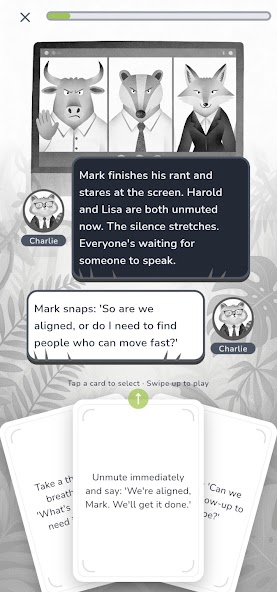
Practise it in SNAXE
Reading the words is easy. Saying them in the moment is harder.
SNAXE puts you in short workplace scenes. You pick what to say, then see what works. Five minutes a day.