
What to say
How to deal with a coworker who talks too much: what to say
The short answer: name your limit, not their flaw. "I want to hear the rest, but I'm on a deadline until 3. Tell me at coffee?" Then turn back to your screen. Most people who talk too much don't see what it costs you. One kind, clear line shows them.
First, a quick check: chatty, or something else?
Someone who talks a lot is not doing anything wrong on purpose. Before you push back, ask yourself three questions.
- Is it everyone, or just you? If they talk to the whole floor, it's their style. If it's mostly you, they may be new, lonely or looking for advice. That needs a warmer answer.
- Is it about work? A long explanation of a task often comes from being unsure. Ask for the short version and what they need from you.
- Does what they say cross a line? Comments about your body, your private life, or politics after you've said no are not chattiness. Skip to the last section.
If it's plain talking too much, use the lines below. They share one move: you talk about your time, never about their personality.
Try it first: what would you say?
The story that won't end
“So then the hotel says the booking doesn’t exist, right? And this is the third time this year. Let me tell you about the first one…”
Martin, your coworker, ten minutes in. It’s 2:20, and your report is due at 3.

Say this, in the moment
-
When they stop by your desk and you're busy
"I want to hear the rest, but I'm on a deadline until 3. Tell me at coffee?"
A limit plus a later time. They don't lose the chat, they only lose the timing. Then look back at your screen. Your body has to agree with your words.
-
When the story is already ten minutes long
"Sorry to stop you. I really need to finish this before 4. Glad the trip worked out in the end."
Close the topic kindly, in the past tense. A friendly last line ends the story better than a slow fade.
-
In a meeting, when they've had the floor for five minutes
"Thanks, Martin. Before we decide, let's hear from a couple of others. Priya, what do you think?"
Thank, then hand the turn to a named person. Naming someone makes the switch happen. "Anyone else?" usually goes back to the talker.
-
In a meeting, when it drifts off the topic
"That's worth its own conversation. Can we park it and come back to the budget? We've got ten minutes."
Point to the agenda and the clock, not the person. Anyone in the room can say this, not just the chair.
-
On a call that won't end
"I've got a hard stop in two minutes. Can we agree the next step?"
Say it early, before you're out of time. Then sum up the next step yourself, so the call can close.
-
When it's a topic you'd rather avoid
"I'd rather not get into politics at work. How's the launch going?"
Say no to the topic, then offer a new one straight away. That keeps it a change of subject, not a rejection.
Make it easier before it starts
The best limit is the one you set before the talking starts. A few small habits do most of the work.
- Open with the time you have. "I've got five minutes before my next thing. What's up?" It's easy to say at the start and hard to say at minute twenty.
- Give meetings a shape. If you run one, say it at the start: "Two minutes each for updates, then we decide." A rule for everyone is easier than stopping one person.
- Move work questions to writing. "Can you put that in a message? I'll answer properly after lunch." Writing is shorter, and you answer when you can.
- Keep some small talk. Saying yes at lunch makes no at 2 pm easier to hear.
Afterwards, one to one
If the in-the-moment lines don't stick, have one short, private talk. Start with what you like, then say what you need.
"Can I ask you something a bit awkward? I really like our chats. But I'm losing a lot of my mornings, and I'm falling behind. Could we keep them for lunch and coffee breaks?"
If they look hurt:
"It's not you. I just need the mornings to get things done. Lunch tomorrow?"
If they forget, a week later:
"Morning is my heads-down time, remember? Catch you at 12."
Expect to repeat it once or twice. A habit takes a few reminders, and a short, friendly one is enough.
Depending on who it is
-
A peer at the next desk
"I'm going to put my headphones on until 3. Not ignoring you, just on a deadline."
Say what the signal means once. After that, the headphones do the talking.
-
Someone more senior
"I'd like to give this proper attention. Can we pick it up at 4, once I've sent the report?"
With a senior person, offer a better time, not a no. It shows you take them seriously, and it protects the work they also need.
-
Someone on your own team
"Your updates have a lot of good detail. In stand-up, give us the headline and the one thing you need. The detail can come after."
Say it in private, as a request for a format. Then hold everyone to the same format in the meeting.
The line people usually say, and a better one
- "You talk too much." True or not, it's about who they are, and people defend who they are. Try: "I'm on a deadline until 3."
- Sighing and one-word answers. Many talkers miss the hint, and everyone else sees you being cold. Say it in words instead.
- A fake phone call. It works once. Then you have to keep doing it, and they still don't know what you need.
- Complaining to the rest of the team. It gets back to them, and now it's a social problem, not a time problem.
- Saying yes to every chat, then staying late. It feels kind. It also tells them the timing works for you.
If it keeps happening: your manager, and when it's HR
If you've asked kindly twice and nothing changes, talk to your manager. Ask for help with your focus, not a judgement about the person.
"I'd like your advice. I'm losing about an hour a day to conversations at my desk, mostly with one person. I've asked them kindly twice. Could we try quiet hours for the team, or could I move desks?"
A team rule, like quiet mornings or shorter stand-ups, fixes it without anyone being singled out. If the talk is about your body, your sex life, your religion, your race or another personal trait, and you've asked them to stop, that is not a focus problem. Take it to HR, with dates and what was said.
Published
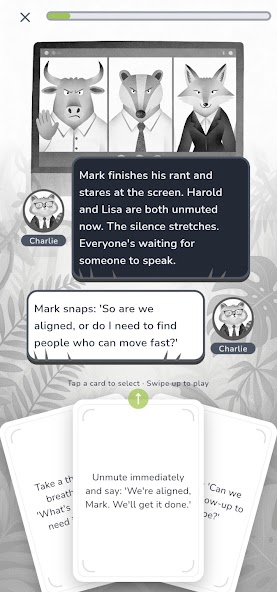
Practise it in SNAXE
Reading the words is easy. Saying them in the moment is harder.
SNAXE puts you in short workplace scenes. You pick what to say, then see what works. Five minutes a day.